
How Your Yosemite Elopement Day Can Naturally Unfold
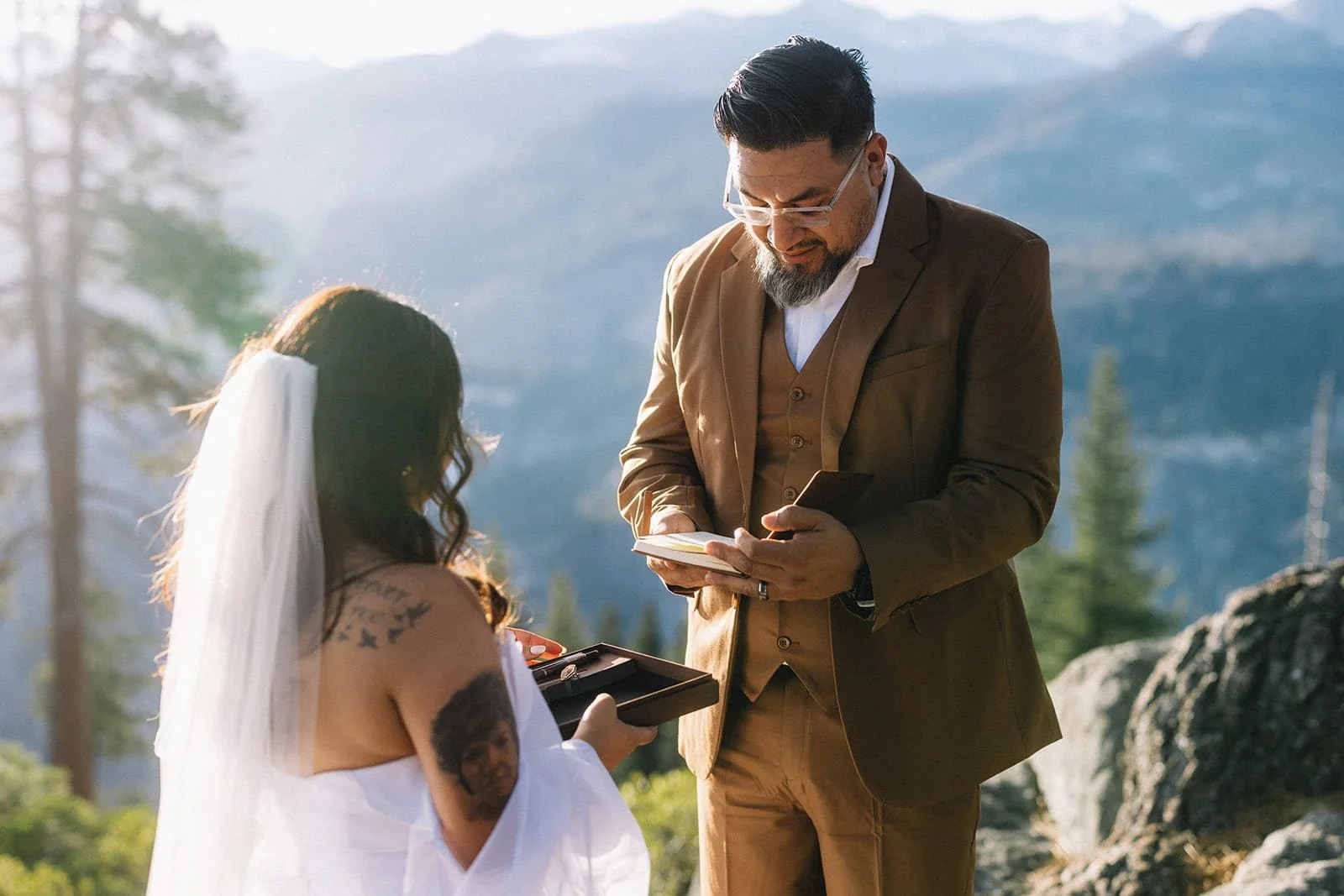
A timeline built around experiences, not the clock
Most couples start planning by searching for a timeline. Usually they find something like this:
2:00 PM — Ceremony. 2:30 PM — Family photos. 3:00 PM — Portraits. 4:00 PM — Reception.
Technically, that's a timeline. But it tells you nothing about how the day will feel.
One reason couples elope in Yosemite is that they want something different. They aren't trying to compress a wedding into six hours. They're choosing to slow down.
So I don't build timelines around photography. I build them around experience.
Because years from now you won't remember that portraits started at 9:15. You'll remember the coffee while the sun came up over the trees, laughing on the drive to Glacier Point, reading your vows with no one else around.
The best timeline doesn't feel like one
Your wedding day should never feel like you're racing a clock. Instead of filling every minute, we leave room for things to happen.
Maybe you stop because the morning light is worth stopping for. Maybe a deer crosses the meadow. Maybe you sit on a granite boulder for five minutes because neither of you wants to move yet.
Those aren't delays. They're the day.
Every timeline I build includes breathing room — not because I expect something to go wrong, but because I expect something good to happen that none of us planned.
Build it backwards
The easiest way to reduce pressure is to plan backwards.
Instead of asking what time should we wake up, ask what do we want the ceremony to feel like.
If it's sunrise at Glacier Point, that becomes the anchor and everything else arranges itself around it. If it's a slow evening beside the Merced River, that's a completely different day.
The ceremony doesn't fit into your timeline. The timeline supports your ceremony.
How long is the ceremony itself?
Shorter than most couples picture, and it varies more than you'd expect.
Ceremony length is something you decide with your officiant, not something the day imposes on you. Some couples want vows, a reading, and a pause. Some want to say the words and be married. Both are complete.
What's worth knowing is that even a full ceremony takes up a small fraction of your day.
Which reframes the question. If the ceremony is the shortest part, the hours you book aren't really about it. They're about everything around it — the drive up, the walk out, the time afterward when the nerves are gone and you're two people who just got married.
So the question isn't how long the ceremony needs to be. It's how much of the rest of the day you want.
Talk to your officiant early about the shape you want. Once you know that, the day length usually becomes obvious.
How long the driving actually takes
Yosemite is bigger than it looks. Here's what that means in practice.
Leave before 8:00 a.m. and the drive to Glacier Point runs about an hour to an hour and a half from most lodging.
Leave after 8:00 a.m. and the same drive stretches to an hour and a half to two hours. In peak season, longer.
Same road, same distance. What changes is how many cars are on it.
There's no way around this. Yosemite has few roads and many visitors, so once traffic builds there's no alternate route and no time to make up. Entrance stations back up, the Valley loop slows, and Glacier Point Road becomes a queue.
What it means for your day: if your ceremony is at Glacier Point or Taft Point, the drive isn't a detail to slot in. Leaving early doesn't save an hour — it's the difference between arriving settled and arriving behind.
This is the practical reason so many couples I work with choose sunrise. You're on the road before the traffic exists, and the hardest part of the logistics is finished before most people have had breakfast.
Five things worth making room for
Every wedding is different, but these five come up again and again.
A slow morning
One of my favorite photographs is almost never taken at the ceremony. It's usually before anyone is dressed — coffee mugs on the table, music playing, sunlight through the cabin windows, someone finishing breakfast.
Ordinary, until it's your wedding day. Leave room for it.
Time together before the ceremony
Some couples see each other beforehand. Some wait. Neither is wrong.
But either way, build in time that's just the two of you. Walk. Drive. Watch the sun come up. The more the day feels like something you're sharing rather than attending, the better it goes.
Space to read your vows
Don't rush them because the schedule feels tight. Read slowly. Pause. Laugh. Look at each other.
Nobody remembers how long a ceremony lasted. They remember how it felt.
Time to explore
Your day doesn't end when the ceremony does. Walk along the river. Watch the sunset. Visit another overlook. Have a picnic. Get ice cream.
Your marriage has already started. Enjoy it.
A quiet ending
Some couples have dinner. Some go back to the cabin and light a fire. Some watch the stars.
However it ends, don't rush home. Give yourselves time to let it land. Couples tell me this is often the part they think about most afterward.
What each length actually holds
Neither a short day nor a long one is better. I've photographed two-hour elopements that felt complete and full days where couples watched both the sunrise and the stars.
The timeline should fit your relationship, not someone else's template.
Two hours
Suited to: just the two of you, a simple ceremony, couples already in Yosemite on a longer trip, vow renewals.
You arrive at your ceremony location while the park is still quiet, and rather than starting with photographs you take a few minutes to settle. Walk. Listen to the river. Look around.
Then vows, unhurried — there's no audience waiting and no reception to keep.
Afterward, rather than treating portraits as a separate event, you explore. Walk the nearby trails, sit on a boulder, watch the light change. The photographs happen while you're doing that.
Before you leave, a few quiet minutes together. A toast, letters, or nothing at all.
A short timeline doesn't mean rushing. It means choosing what matters.
Four hours
Suited to: sunrise or sunset ceremonies, two locations, small family groups.
The day starts where you're staying — coffee, getting ready, the quiet before.
Then the drive in. I never want couples to feel like transportation is dead time. Music, conversation, Yosemite appearing around each corner. That counts.
Ceremony, unhurried. Then a second location rather than four hours in one place: Glacier Point and Sentinel Beach, Cathedral Beach and Valley View, Tenaya Lake and Olmsted Point.
Finish with champagne, a picnic, or sitting together watching the light go.
Six hours
Suited to: couples who want the fuller Yosemite experience and time in more than one part of the park.
A slow morning. Breakfast, getting ready, reading letters.
A first look, if you want one — a chance to be together before the ceremony rather than seeing each other for the first time in front of everyone.
Then a scenic drive rather than a direct one, stopping when something's worth stopping for.
Ceremony. Then genuine exploring: another overlook, a walk through forest, time beside the Merced River.
Dinner inside the park or back near where you're staying. Couples often tell me this is when it starts to sink in.
Eight hours
Suited to: couples who want Yosemite to be the whole day, sunrise-to-sunset plans, and anyone travelling a long way for this.
Sunrise first, before most visitors arrive. Coffee, a walk, the quiet.
Back to the cabin for breakfast and getting ready, unhurried.
A first look somewhere that means something — outside the cabin, under the pines, overlooking the Valley.
Ceremony at your location, with nobody watching a clock.
Then the afternoon keeps going rather than ending. Drive Tioga Road. Visit Tenaya Lake. Walk Tuolumne Meadows. Picnic. This is your honeymoon starting, not your wedding finishing.
Sunset somewhere peaceful. Watch the last light go across Half Dome. No cameras for a few minutes.
Then celebrate however you want — dinner, champagne, a fire, stars. Let it end slowly.
Two variations worth considering
Bringing family
Including family doesn't have to make the day heavier. The mistake I see most is trying to keep everyone together from sunrise to sunset.
Instead, let different parts of the day belong to different people. The first hours are yours — coffee, getting ready, the calm. Family joins for the ceremony, which lets them witness the part that matters without joining every mile of it. Afterward: hugs, photographs, a toast, unhurried.
Then the two of you keep exploring on your own. Couples tell me this balance gives them both things — their people included, and the day they pictured.
H3 · Spreading it across days
Your wedding doesn't have to fit in one day. If you're travelling to one of the most remarkable places in the country, there's an argument for staying.
Day one: arrive, settle in, dinner, sunset, and the anticipation of tomorrow. Day two: the wedding, with no packing and no checkout time. Day three: sleep in. See what you missed. Walk Cook's Meadow, visit Mariposa Grove, drive Tioga Road.
That third day is often the one couples describe as the most restful of the trip.
Sunrise or sunset?
The most common planning question, and the answer has less to do with photography than with who you are.
Choose sunrise if you like having the park nearly to yourselves. Roads are quieter, parking is easier, temperatures are cooler, and the light is soft. Your ceremony becomes the start of the day rather than the end — which leaves the whole day to celebrate afterward.
Choose sunset if you'd rather ease in. Breakfast together. Family arriving. No early alarm. The anticipation builds through the day, and afterward you can have dinner under the stars.
Both work. The right one is whichever sounds more like you.
Seasonal adjustments
Every season here calls for a slightly different shape.
Spring — waterfalls are at their strongest. Mornings stay cold, so build in time to warm up after a sunrise ceremony. Weather changes fast, so keep the plan flexible.
Summer — the longest daylight of the year, and the most freedom to spread out. Afternoons get warm, which makes sunrise and sunset the comfortable windows. Crowds are heaviest, so allow more travel time between locations.
Fall — comfortable temperatures and better light. Daylight shortens, so ceremonies start earlier than couples expect. The quieter pace makes it one of my favorite stretches of the year.
Winter — later sunrises mean later starts. Snow affects travel times, so flexibility matters more. The park is remarkably quiet.
What to do between locations
Some couples worry about dead time.
Honestly, some of the best parts of the day happen between places. Rather than asking how to fill the time, ask how to spend it.
Stop for coffee. Share a picnic. Sit in a meadow. Watch climbers on El Capitan. Skip rocks on the Merced. Get ice cream in Yosemite Village. Sit without talking.
Not every minute needs to produce a photograph.
What if something doesn't go to plan
Something almost always does. Traffic is slower than expected. The weather turns. You lose track of time over coffee. You find a viewpoint you didn't know was there.
None of that ruins a wedding day. It's just what the day was.
On rain specifically: it doesn't ruin Yosemite, it changes it. Granite darkens, the forest smells incredible, clouds move between the cliffs, and waterfalls get more dramatic. I've photographed ceremonies under clear skies and in light rain. Both were good.
The point of leaving room in a timeline is that real days don't run on a tidy schedule. We might shift the ceremony half an hour, start somewhere sheltered, or reverse the order of locations. Flexibility is one of the real advantages of eloping. Use it.
Mistakes worth avoiding
Trying to visit every famous viewpoint. Driving takes time. Parking takes time. Walking takes time. Six locations in one day creates pressure for no return. Choose two or three you actually care about and experience them properly.
Scheduling every minute. Leave gaps. The unplanned parts are usually the ones you talk about afterward.
Forgetting to eat. It sounds obvious and it happens constantly. Between adrenaline and excitement, couples reach late afternoon having eaten nothing. Pack snacks. Bring water. Plan a real meal.
Not pausing. After the ceremony, before we move on — stop for one minute. No cameras, no talking. Notice the trees, the cliffs, the air. Notice the ring. Notice the person next to you. You won't get that minute again.
How I build every timeline
Before I pick up a camera, I'm working on a different question: how do I make this day feel effortless?
Every timeline starts with questions like — when do you feel most like yourselves? Are you early risers or slow-morning people? Do you enjoy hiking? Would you rather spend an hour exploring or an hour sitting by the river? Do you picture the day as active or calm?
Those answers shape everything. The photography follows.
AJ's note
Couples often apologise for not being good in front of a camera. Almost every one of them says it.
You don't have to know what to do with your hands. You don't have to perform. You don't have to spend your wedding day thinking about me.
My job is to leave enough space that you forget I'm there. When you're laughing, walking, or quietly reading your vows — that's when the honest photographs happen.
Bringing it together
Every timeline here has one thing in common: none of them were built around photography. They were built around people.
That's deliberate. Years from now you won't remember that portraits started at 4:15. You'll remember how the morning smelled after a cold Yosemite night, laughing on the drive to Glacier Point, and finally reading vows you'd been carrying in your pocket for months.
That's what a timeline should protect. Not the schedule. The experience.
Continue Planning Your Yosemite Elopement
Now that you have a sense of how your day might unfold, here's where to go next:
Read Next
Choosing Your Ceremony Location – find the Yosemite location that fits what you're picturing.
The Best Time to Elope in Yosemite – every season compared, from spring waterfalls to winter snow.
Where to Stay for Your Yosemite Elopement – accommodations that fit your timeline.
Yosemite Wedding Permit Guide – how permits work and what you'll need.
Frequently Asked Questions About Eloping in Yosemite – answers to the most common planning questions.
Ready to Start Planning Your Day?
Every couple I work with gets a timeline built around them rather than a template.
We'll talk about what matters most to you, how you actually spend time together, and what you want to remember years from now. Then we build a day that gives those things room.
Because a wedding isn't measured by how many locations you reach or how closely you follow a schedule. It's measured by how it felt to stand somewhere remarkable and start your marriage.