
What a Lake Tahoe Elopement Day Actually Looks Like
Nearly every couple asks some version of the same question: how long do we actually need?
It's a hard one to answer in the abstract, because most people have never been photographed for a whole day and have no reference for how it feels. Four hours sounds like plenty. Eight sounds like far too much. Both instincts are usually wrong.
So here's what each length actually holds — the sequence, roughly how long each piece takes, and what the extra hours buy you.
No clock times, on purpose. Sunset at Tahoe moves about three hours between June and December, so a schedule built on times would be wrong for half of you. Everything below is anchored to the light instead.
First: your ceremony is shorter than you think
Most ceremonies run about twenty minutes. A few come in around ten. Almost none go longer.
That surprises people, and it reframes the whole question. If the ceremony is twenty minutes, then everything else in your day — however long you book — is the part where you're not getting married. It's the walking, the sitting somewhere with a view, the drive between locations, the quiet after.
Which means the real question isn't how long your ceremony needs. It's how much of the rest you want.
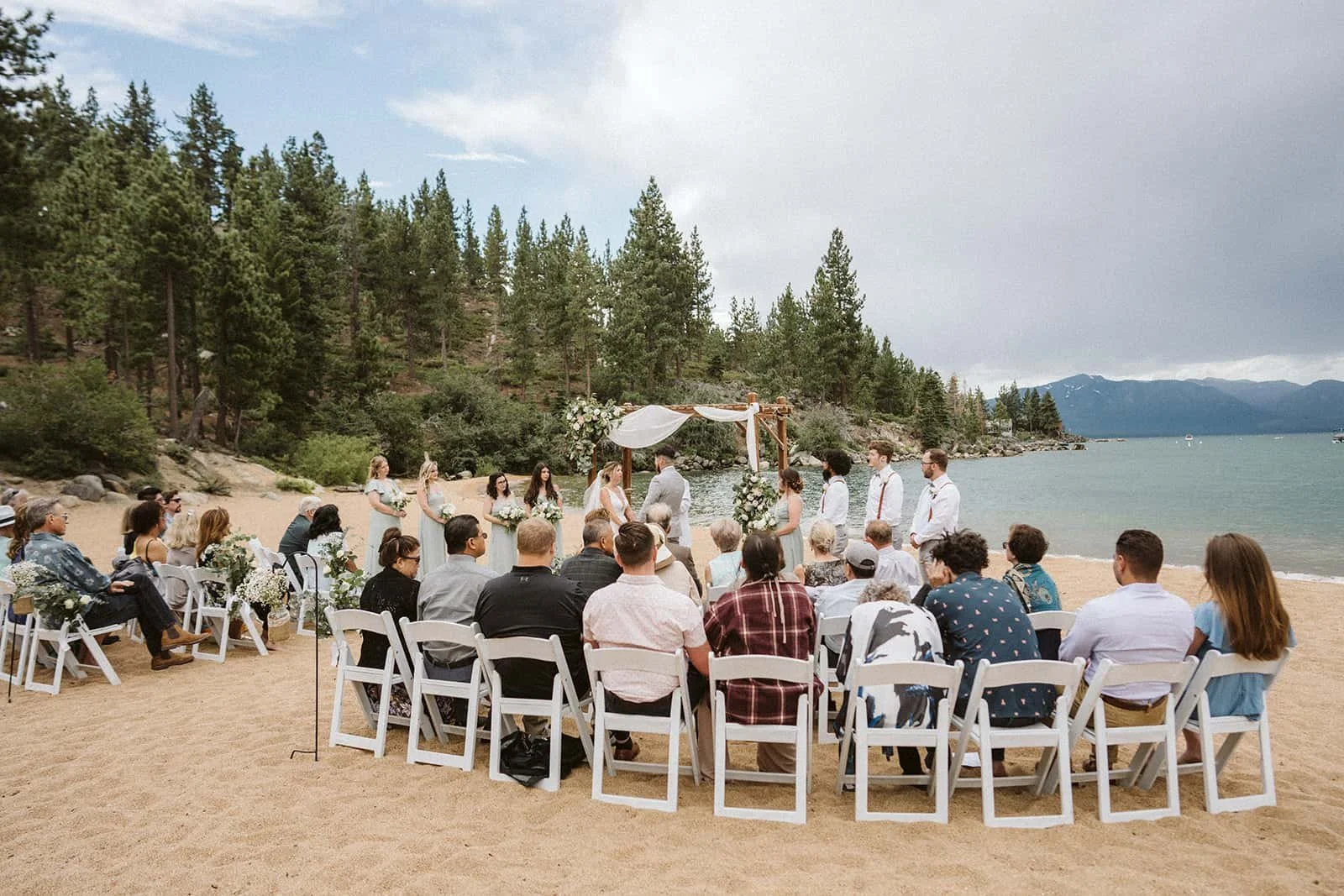
The light decides the shape
Before the durations, one thing that shapes every Tahoe timeline: which shore you're on.
East shore — Sand Harbor, Cave Rock, Zephyr Cove, Logan Shoals — faces west across the water. These days are built backward from sunset. The ceremony lands in the last stretch of good light, and everything before it works toward that.
West shore — D.L. Bliss, Emerald Bay, Eagle Rock — faces east. These days are built forward from first light. You start early, the ceremony happens in soft morning light, and the day opens up in front of you afterward.
Same duration, opposite construction. It's the first thing I settle when we start planning, because everything else follows from it.
Four hours
The Half-Day Experience. One location, straightforward sequence.
How it runs: you arrive and we take a few minutes to settle. Ceremony, about twenty minutes. Then portraits at the same location for the bulk of the remaining time — moving around the site, walking, stopping where the light is doing something.
What four hours holds: the ceremony and unhurried portraits at one place. No second location, no getting ready, no travel built in.
Who it fits: couples who know exactly where they want to stand and don't need the day to be an event. It works especially well at Logan Shoals or Cave Rock, where the location is the whole point and there's no reason to be anywhere else.
What it doesn't hold: getting ready, a first look, a second location, or anything after the portraits. If any of that matters to you, four hours will feel tight.
Six hours
The Full-Day Experience. Two locations, and room between them.
How it runs: ceremony at the first location, then portraits there. Travel to a second spot — often somewhere quieter, or somewhere with a different character entirely. More portraits there, ending in the best light of the day.
What the extra two hours buy: the second location, and the drive between. That drive matters more than it sounds. It's the stretch where the ceremony has already happened, the nerves are gone, and you're just two people in a car who got married an hour ago. Some of the best frames of the day come after it.
Who it fits: most couples. This is the one I recommend when someone isn't sure, because it holds the whole ceremony-and-celebration arc without needing an early start.
Eight hours
Sunrise to Sunset. The whole day, and the one couples struggle to picture.
How it runs:
Getting ready. Wherever you're staying. Not a production — just the last quiet stretch before it starts.
First look, at its own location. Somewhere separate from the ceremony site. This is the piece that changes everything downstream: by the time you reach the ceremony, you've already seen each other, you've already been in front of the camera, and you're not carrying the nerves you would have been.
To the ceremony location. Vows, about twenty minutes.
Portraits. On site, or at another location if the day calls for it.
Cake cutting and a champagne toast. Small, and worth doing. It's the point where the day stops being a schedule and becomes a celebration.
Sunset portraits. The last light, and the end of it.
What eight hours actually buys: not more photographs. A day that doesn't rush. Every piece above has room around it, nothing runs into anything else, and there's no point where you're being moved along.
Who it fits: couples bringing guests, couples who want the getting-ready and first-look parts, and anyone whose instinct is that they'd rather not watch the clock on their wedding day.
One location that changes the math
Emerald Bay limits you to thirty minutes at the ceremony site, including photos.
That doesn't rule it out — it just means the day has to be built differently. Your ceremony happens there, and everything else happens elsewhere. Portraits at a second location, and whatever comes after at a third.
Any Emerald Bay timeline is really a two-location timeline, whatever length you book. Worth knowing before you plan around it.
How I build yours
Once we've settled the location and the length, I work backward or forward from the light depending on which shore you're on, then place the ceremony where it sits best, then arrange everything else around it.
You get the whole thing written out before your day — where to be, when, and what happens next — so you're not making decisions on the morning of your wedding.
Common questions
How long does an elopement ceremony take? About twenty minutes. Some run closer to ten. Almost none go longer.
How many hours do we need for a Lake Tahoe elopement? Four covers a ceremony and portraits at one location. Six adds a second location and the travel between. Eight covers getting ready, a first look, the ceremony, portraits, a toast, and sunset.
What does an eight-hour elopement day include? Getting ready, a first look at its own location, travel to the ceremony site, the ceremony, portraits, a cake cutting and champagne toast, then sunset portraits. The length isn't about more photographs — it's about none of it being rushed.
Should we do a first look? It's worth considering on a longer day. Seeing each other beforehand means you arrive at the ceremony already settled, which shows in everything after.
Sunrise or sunset ceremony? Depends on your shore. The east side — Sand Harbor, Cave Rock, Zephyr Cove, Logan Shoals — faces west and works best toward sunset. The west side — D.L. Bliss, Emerald Bay, Eagle Rock — faces east and works best in the morning.
Can we get married at Emerald Bay and stay all day? No — the ceremony site allows thirty minutes including photos. An Emerald Bay day means the ceremony there and everything else at another location.
Continue Planning Your Lake Tahoe Elopement
Now that you have a sense of how the day runs, here's where to go next:
Where to Elope at Lake Tahoe — seven locations compared by light, access, and group size
The Best Time to Elope at Lake Tahoe — season by season, with sunrise and sunset times for every month
Lake Tahoe Elopement Permits and Marriage Licenses — what your location requires and what it costs
How Much a Lake Tahoe Elopement Costs — how the hours you choose affect the total
Lake Tahoe Elopement Questions — guests, dogs, what to wear, and what happens if it rains
How to Elope at Lake Tahoe — the full planning guide, start to finish
Let's build yours
Once we've settled where and when, I write the whole day out — where to be, what happens next, how long each part takes. You get it well before your date, so nothing is being decided on the morning of your wedding.
Tell me what you're picturing and we'll start there.