
The Real Challenges of Planning a Yosemite Elopement (And Exactly How to Solve Them)

Every couple who starts researching a Yosemite elopement quickly discovers that the park comes with a planning complexity that no other elopement destination quite matches. The permit system is specific. The timed entry reservations are a moving target. The crowds at iconic locations can be overwhelming. The weather changes fast. And the logistics of coordinating all of it — while also trying to plan the most meaningful day of your life — can tip from exciting into genuinely stressful.
None of these challenges is insurmountable. But going in without understanding them is how couples end up with a permit for the wrong site, a ceremony location that fills with day hikers before 9 AM, or a timeline that falls apart because nobody accounted for the entrance reservation queue.
This is the guide we wish every couple read before they started planning. Seven years and dozens of Yosemite elopements later, here is every major challenge — and exactly how it gets solved.
Challenge 1: The Permit System Is Specific and Unforgiving
-
Yes. Every elopement or wedding ceremony in Yosemite National Park requires a National Park Service Special Use Permit regardless of group size. The permit fee is $150, paid by check or money order. Applications must be received at least 21 days before your date and can be submitted up to one year in advance. The park issues a maximum of 60 permits per month during peak season (May–October).
The Yosemite permit system is not complicated in concept — fill out the form, choose your site, mail the $150 fee, wait for approval. Where couples consistently run into problems is in the details.
The most common permit mistakes
• Applying too late — the park needs at least 21 days but popular dates in September and October fill months in advance. Submitting in July for a September date is genuinely risky.
• Choosing the wrong ceremony site — for groups of 11 or fewer, ceremonies can take place almost anywhere in the park. For larger groups, you are limited to 13 designated sites. Couples who do not know this rule sometimes submit applications for locations the park will not approve for their group size.
• Not listing all attendees — the permit application requires a total headcount including the couple, guests, photographer, officiant, and any other vendors. Undercounting creates complications on the day if a ranger checks.
• Forgetting the park entrance fee — the $150 permit fee and the $35 per-vehicle park entrance fee are separate. The permit does not waive the entrance fee for anyone attending your elopement.
• Missing the mailing address — applications are submitted by physical mail to the Special Park Uses office in El Portal, CA. There is no online submission. Couples who try to submit digitally cause delays.
How to solve it
Apply as early as possible — up to one year in advance for popular dates. List a primary ceremony site and a backup on your application. Include every person who will be present in your headcount. Mail the application by certified mail so you have confirmation of receipt. Bring a printed copy of your approved permit on the day — rangers do check.
HOW AJ HANDLES THIS FOR YOU
Permit guidance is included in every Yosemite elopement booking. We walk you through the application, help you choose the right ceremony site for your vision and group size, review the form before you mail it, and confirm the timeline so your permit arrives well before your date. We have done this dozens of times — there are no surprises left.
Challenge 2: Timed Entry Reservations Add a Layer of Complexity
-
Yes, during peak season. Yosemite requires timed entry vehicle reservations on specific high-traffic dates from late May through early September (dates vary annually). Couples staying inside the park or who have on-site lodging are exempt. Reservation slots are released 90 days in advance and sell out quickly. Having a ceremony permit does not exempt you from the timed entry requirement.
Yosemite's timed entry system is one of the most misunderstood planning elements for elopement couples. The permit and the timed entry reservation are two completely separate systems managed by two different processes. Having one does not guarantee or waive the other.
Why this trips couples up
The timed entry reservations are released 90 days in advance on recreation.gov and sell out within minutes for peak summer weekends. Couples who secure a ceremony permit — sometimes months in advance — then discover that vehicle reservations for their specific date are no longer available. This is a real planning problem that has caused elopements to be rescheduled.
How to solve it
• Book lodging inside the park — staying at The Ahwahnee, Yosemite Valley Lodge, Half Dome Village, or any other in-park accommodation exempts your vehicle from the timed entry requirement. This is the cleanest solution.
• If not staying in the park, set a calendar alert for 90 days before your date and be on recreation.gov at exactly the release time. Slots go in the first few minutes.
• Choose a date outside the timed entry window — fall dates in late September and October, and all winter dates, typically do not require timed entry reservations. This is one of several reasons fall is our most consistently recommended season for Yosemite elopements.
• Start early — for sunrise ceremonies, the park entry period for your date may allow entry before the reservation window even activates, depending on the specific day's system.
IMPORTANT NOTE FOR 2026
Yosemite's timed entry dates and requirements change annually. Check the current year's schedule at nps.gov/yose before finalizing your date. We monitor these dates for every couple we book and advise on whether your specific date requires a vehicle reservation.
Challenge 3: Crowds at Iconic Locations Can Ruin the Intimacy
-
Yosemite receives 4 to 5 million visitors per year, the majority concentrated in summer. Tunnel View, Glacier Point, and Yosemite Valley can have hundreds of people by 9 AM on peak days. However, the same locations at 5:30 to 6:30 AM on the same days can have fewer than 10 people. Sunrise timing is the single most effective crowd management tool for Yosemite elopements.
The crowd challenge at Yosemite is real and it is specific to certain locations and certain times. At 10 AM on a July Saturday, Tunnel View has tour buses, families, and hundreds of photographers all working the same composition. At 5:45 AM on that same day, the same viewpoint may have three or four other people and the most extraordinary light you have ever seen.
The locations where crowds are most challenging
• Tunnel View — the most popular drive-up viewpoint in the park, fills fast in summer. Sunrise-only for intimate elopements from June through August.
• Glacier Point — receives overnight lodge guests who sometimes gather for sunrise. Less crowded than valley floor but not private by 9 AM in summer.
• Yosemite Falls Trail — extremely popular summer trail, essentially impossible to have a private moment at the base of the falls by mid-morning.
• Valley floor meadows — Cook's Meadow and Sentinel Meadow are more forgiving but still fill with photographers and walkers by 8 to 9 AM in summer.
The locations that stay private
• Taft Point at sunrise — the 2.2-mile pre-dawn hike means almost no other visitors at the cliff edge before 7 AM, even in summer.
• Sentinel Dome at sunrise — same trail, same pattern. The moderate hike filters out casual visitors at early hours.
• D.L. Bliss and Rubicon Trail (Tahoe) — off-peak for most visitors, consistently quiet even in summer.
• Off-trail and non-designated locations — for groups of 11 or fewer, the flexibility to go almost anywhere in the park is the most powerful privacy tool available. We know locations that see virtually no visitor traffic at any hour.
How to solve it
For popular viewpoints in summer — sunrise is non-negotiable. For couples who specifically want privacy at locations like Taft Point or Sentinel Dome, the pre-dawn hike is what makes it possible. For couples who cannot do early mornings, fall and winter dates at the same locations give you a window of quiet that summer simply does not offer.
THE SUNRISE ADVANTAGE
In seven years of Yosemite elopements, we have never had a sunrise ceremony disrupted by crowds at the locations we use. By the time other visitors begin arriving — typically 8 to 9 AM at elevated locations, earlier at drive-up spots — the ceremony is done and we are already into portrait sessions in quieter areas. The early alarm is worth it every time.
Challenge 4: Yosemite Weather Changes Fast and Without Much Warning
-
Yosemite weather varies dramatically by season and elevation. Summer afternoons bring frequent thunderstorms, particularly at high elevations. Spring snowmelt can make some trails muddy or dangerous. Winter brings road closures and cold temperatures. Fall (September–October) has the most stable weather of any season. Smoke from Sierra Nevada wildfires can affect visibility and air quality from July through September.
Yosemite sits in the Sierra Nevada at elevations ranging from 2,000 to over 13,000 feet. Weather patterns that are mild in the valley can be serious at elevation. An afternoon that starts sunny in Yosemite Valley can end in a thunderstorm at Taft Point. The park's terrain creates its own microclimate patterns that differ significantly from general Sierra Nevada forecasts.
Summer thunderstorms
Late afternoon thunderstorms are common in Yosemite from June through August, particularly at elevations above 7,000 feet. The pattern is predictable enough to plan around — morning ceremonies almost always clear the storm window. Taft Point and Sentinel Dome ceremonies that begin at 5 to 6 AM and conclude by 9 to 10 AM are almost never affected by afternoon weather. Ceremonies scheduled for 2 PM on a summer day at an elevated location are exposed.
Wildfire smoke
Sierra Nevada wildfires from July through September can create significant smoke and haze in Yosemite, particularly in the valley where smoke settles. In heavily smoky conditions, mountain views are obscured and air quality can be poor. We monitor air quality indexes for every summer elopement we book and have contingency plans for smoke — including adjusting timing and location. Some of our most atmospheric photographs have been taken in light smoke — the haze creates a diffuse golden quality that photographs beautifully in the right conditions.
Spring and snowmelt
April and May bring the waterfall season to peak, but also snowmelt that makes some high elevation trails muddy, unstable, or still snow-covered. Taft Point and Sentinel Dome trails may retain snow patches into late May. We check trail conditions weekly in spring for every upcoming elopement and advise on trail-specific conditions before the date.
How to solve it
• Build a weather contingency into every timeline — an alternative location that is accessible regardless of conditions at the primary site.
• Morning ceremonies avoid the afternoon storm window almost entirely in summer.
• Fall dates (September–October) have the most stable weather of any season in Yosemite — warm days, cold nights, and dramatically lower storm probability than summer.
• Monitor conditions in the week before your date, not just the long-range forecast — Sierra Nevada weather is best read at 7 to 10 days out.
OUR WEATHER PROTOCOL
For every elopement we book, we begin monitoring weather and trail conditions one week before the date. If conditions at the primary location are problematic, we have a backup location identified and agreed upon in advance. In seven years of Yosemite elopements, weather has never prevented a ceremony from happening — it has occasionally changed the location or timing.
Challenge 5: Getting the Marriage License Requires Advance Planning
-
Yosemite Valley ceremonies fall primarily within Mariposa County, California. Marriage licenses are issued by the Mariposa County Clerk-Recorder in Mariposa — approximately 45 minutes from Yosemite Valley. The Mariposa office is open limited weekday hours. A confidential license costs approximately $144 (no witness required). A public license costs $60–100 (one witness required). Both are legally equivalent. Couples traveling from out of state can obtain a California license from any county clerk in the state.
The marriage license is the most consistently overlooked logistical element in Yosemite elopement planning. Most couples know about the NPS permit — far fewer think about the marriage license until they are already deep in planning.
Why the Mariposa County office is a planning constraint
The Mariposa County Clerk is open limited weekday hours and is not open on weekends. For couples eloping on a Saturday or Sunday — the most common elopement days — the license needs to be obtained in advance during the week. Couples traveling from out of state often need to plan their travel itinerary around a mid-week courthouse visit.
The confidential license advantage for elopement couples
California's confidential marriage license requires no witness — only the couple and an authorized officiant. This is the most popular choice for elopement couples because it removes the witness logistics entirely. It is sealed from the public record, which some couples also prefer. The $40 to $80 premium over the public license is worth it for most elopement couples.
Out-of-state couples
Couples traveling from outside California can obtain a California marriage license from any county clerk in the state — it does not need to be Mariposa County specifically. If you are flying in and arriving in the Los Angeles or San Francisco area, you can obtain a California license from Los Angeles County or San Francisco County before driving to Yosemite. We advise on the most practical option based on each couple's travel itinerary.
How to solve it
• Plan a weekday trip to the Mariposa County Clerk at some point before your elopement date — ideally one to two weeks before to avoid any timing pressure.
• If that is logistically difficult, obtain a California license from a county that works with your travel itinerary.
• Choose the confidential license — it removes the witness requirement and the ceremony logistics stay simple.
• Confirm current hours for the Mariposa County Clerk before you go — call ahead or check their website, as hours can vary.
Challenge 6: Timeline Logistics Are More Complex Than They Look
A Yosemite elopement timeline involves more moving pieces than most couples anticipate when they start planning. The permit site. The timed entry reservation or exemption. Travel to and from the location. Trail time in both directions. The ceremony itself. Portrait sessions. Warm-up windows if it is cold. Return to the car before other visitors arrive. Accommodation check-in. All of these need to be sequenced in a way that accounts for both the ideal outcome and the contingencies.
The most common timeline mistakes
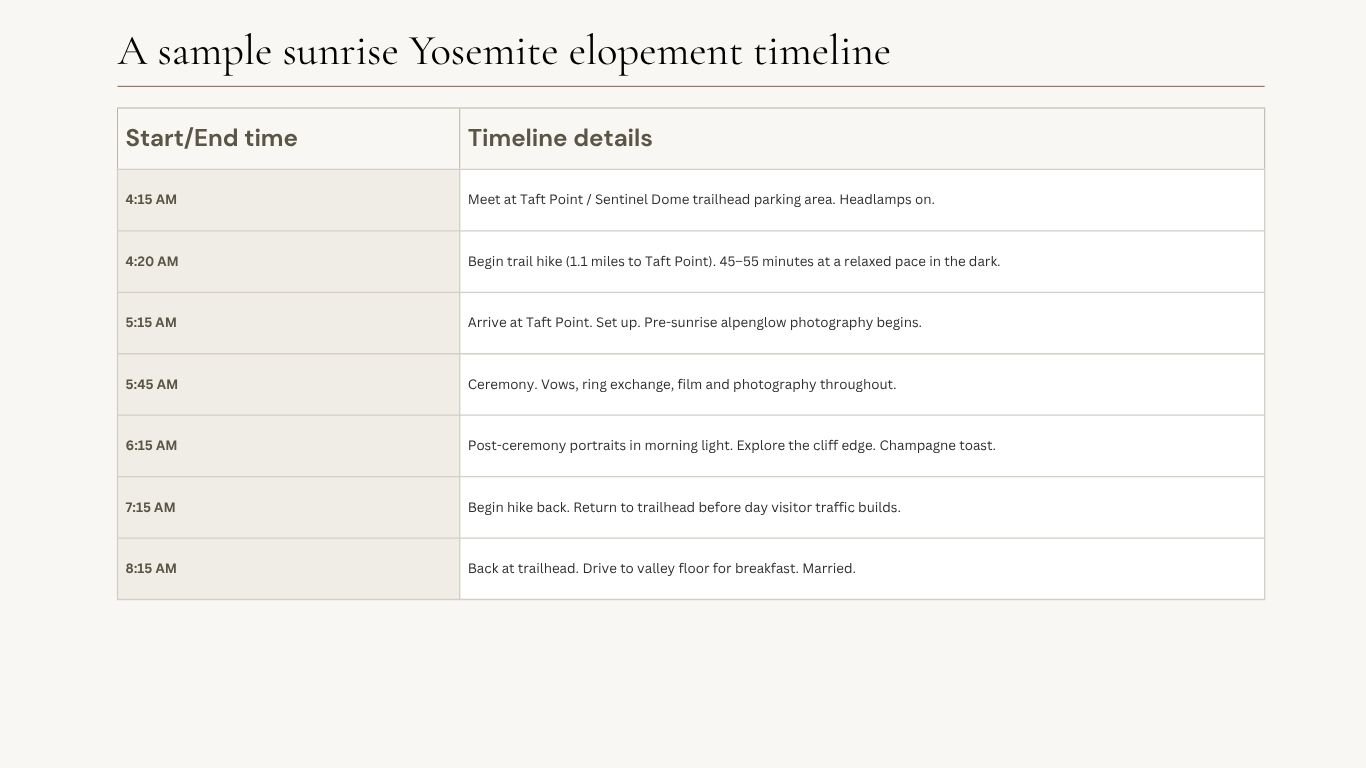
• Not building in enough trail time — distances on trail maps are one-way. A 1.1-mile trail to Taft Point takes 45 to 55 minutes in the dark with headlamps. Building only 30 minutes causes rushed arrivals and missed light.
• Scheduling the ceremony too late — at sunrise ceremonies, the best light window is often 20 to 45 minutes. Starting the ceremony 15 minutes after sunrise instead of before it misses the alpenglow entirely.
• Forgetting travel between locations — couples who want both a ceremony and a separate portrait session at a different location often underestimate the drive time between them, particularly in summer when valley traffic is slow.
• Not planning the return — at sunrise ceremonies, the ideal is to be back at the car before the main visitor flow arrives. Not planning the return time means the post-ceremony time is rushed when it should be the most relaxed part of the day.
• Skipping the warming-up window — at cold-weather or winter ceremonies, not building 15-minute warm-up breaks into the timeline leads to cold, tense photographs that lack the ease of a couple who is comfortable.
Challenge 7: Finding Vendors With Real Yosemite Experience
Yosemite is one of the most popular elopement destinations in the United States, which means there is no shortage of photographers marketing Yosemite elopement services. The quality and experience gap in this market is significant — and because the stakes are high on your elopement day, who you hire matters more here than at a traditional venue.
What real Yosemite experience looks like
• Knowledge of specific light conditions at specific locations in specific seasons — not general outdoor photography experience.
• Direct experience navigating the permit application process, not just awareness that permits exist.
• Familiarity with the timed entry system and contingency planning experience when access is complicated.
• Terrain experience — photographers who have hiked to Taft Point before dawn know what the trail is like in the dark, which affects the timeline and the experience. Photographers who have not done it are figuring it out on your elopement day.
• Weather contingency experience — knowing which valley floor locations still work when smoke or storms affect elevated sites.
Questions to ask a Yosemite elopement photographer
• How many elopements have you photographed at this specific location in Yosemite?
• Can you describe what the light looks like at that location at the time of year we are considering?
• Have you personally navigated the NPS permit process, or do you advise couples to handle it themselves?
• What is your contingency if our primary location is inaccessible on the day?
• What does your pre-dawn trail experience look like — have you done this specific hike in the dark?
SEVEN YEARS IN YOSEMITE
AJ Photography NV has photographed and filmed elopements across every season and at more than a dozen Yosemite locations. The permit process, timed entry navigation, terrain knowledge, weather contingency planning, and vendor coordination are all part of what you get when you book — not things you have to figure out alongside us.
Challenge 8: Coordinating Multiple Vendors Across a Complex Day
A Yosemite elopement that includes a photographer, videographer, florist, hair and makeup artist, and officiant involves five separate vendor relationships — each with their own contracts, communication styles, and expectations for the day. When those five vendors have never worked together and are all navigating Yosemite logistics for the first time, the coordination burden falls on the couple.
Why the multi-vendor model creates problems in Yosemite specifically
A traditional wedding venue handles vendor coordination as part of its service. Yosemite does not. The park does not coordinate vendors, manage timelines, or ensure that your photographer and videographer are in communication. Every vendor is operating independently, navigating their own timed entry reservations, arriving at their own times, and working from their own understanding of the timeline.
We have spoken with couples who experienced their ceremony videographer arriving late because of a timed entry delay, while the photographer who understood the system was already at the location. The ceremony started without video coverage of the processional. This kind of failure is entirely preventable with proper planning — but it requires someone to own the coordination.
The single-vendor advantage for Yosemite elopements
Booking a photographer who also films removes the coordination variable entirely. One person, one timeline, one set of timed entry logistics, one creative vision. The planning conversation is simpler, the day is simpler, and the deliverables — your photographs and film — share a consistent aesthetic because they came from the same creative. For Yosemite specifically, where the logistics are already complex, removing one major coordination variable makes a measurable difference to the experience.
Frequently Asked Questions
How hard is it to plan a Yosemite elopement?
More complex than most destinations — but entirely manageable with advance planning. The two biggest sources of complexity are the NPS permit system (straightforward once you understand it, but specific) and the timed entry vehicle reservation system for peak season dates. Fall and winter dates avoid most of the timed entry complexity. Working with a photographer who has navigated these systems before removes most of the learning curve.
What is the biggest mistake couples make when planning a Yosemite elopement?
Starting too late. The NPS permit has a 60-permit-per-month cap during peak season and can fill months in advance. The timed entry reservations release 90 days before the date and sell out in minutes for peak weekends. Couples who start planning 6 to 8 weeks before their date are working against the system. Start 6 to 12 months out for summer and fall dates. Three to four months is workable for winter dates.
Can you elope in Yosemite without a permit?
No — not legally. Any organized wedding or elopement ceremony in Yosemite National Park requires an NPS Special Use Permit regardless of group size. Attempting a ceremony without a permit risks a fine and removal from the location by park rangers. The permit process is not difficult, the fee is reasonable, and having the permit gives you the legal and logistical clarity to hold your ceremony without interruption.
How far in advance should you start planning a Yosemite elopement?
For summer and fall dates (May through October): 8 to 12 months in advance is ideal. This gives you time to secure both the permit and the timed entry reservation, book vendors before their calendars fill, and build a thorough contingency plan. For winter dates (November through April): 3 to 6 months is typically sufficient, as permit availability and timed entry requirements are less constrained.
What happens if it rains on your Yosemite elopement day?
Light rain in Yosemite creates extraordinary atmospheric conditions — misty valley views, dramatic cloud formations, and a quality of light that photographs in a completely different way than clear sky. Most couples who experience light rain during their elopement say they would not change a thing. Heavy rain or lightning at elevated locations requires moving to a valley floor alternative — which is why we have a named backup location agreed upon for every elopement we book, regardless of the forecast.

READY TO PLAN YOUR YOSEMITE ELOPEMENT?
Every challenge in this guide is one we have navigated dozens of times. Permits, timed entry, crowd management, weather contingencies, vendor coordination, timeline building — this is what we do, and it is included in every booking. Reach out through the form below and I’ll will respond personally within 24 hours. No automated replies. No sales pressure. Just an honest conversation about your vision and whether we are the right fit.
